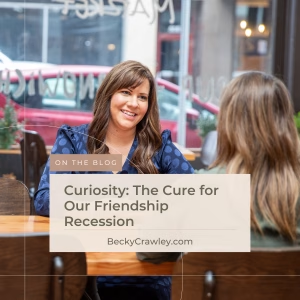
Friendship is meant to be a place that calls us forward—a place where we are deeply known and deeply seen. It’s a space that draws us out of isolation and into connection, where our hearts can be witnessed and loved.
And yet, if we’re honest, isolation has quietly become the goal of modern life.
We order our food through apps instead of gathering around a table.
We have groceries delivered so we don’t have to make small talk.
We stream movies instead of going out with friends.
We outsource community to social media.
We trade embodied fellowship for online church.
There is nothing sinful or shameful about any of these conveniences. In fact, in certain seasons—especially seasons of motherhood, burnout, grief, or transition—these tools can feel like lifelines.
The danger comes when convenience becomes a hiding place. When efficiency replaces intimacy. When we trade connection for control.
Because Jesus did not create us for isolation. He created us for relationship.
The Friendship Recession
Research shows that 1 in 3 people in America feel lonely at least once a week, and 1 in 4 people report having no close friends at all. Sociologists have begun calling this moment a friendship recession—a decline in both the quantity and quality of meaningful relationships.
We are more connected digitally than ever before, and yet more disconnected emotionally, spiritually, and relationally.
Over the next few weeks, we’re exploring four attributes of friendship that Jesus modeled—four relational “cures” for this moment. Today, we’re starting with the first C: Curiosity.
The Ethos Behind Curiosity
During my years working in Christian publishing, I was shaped by a framework called the Four Acts of Love. These values weren’t just words on a wall—they were lived, practiced, and embodied.
Radical Hospitality – Creating welcoming environments with our hearts and our actions.
Fearless Conversation – Engaging in honest, courageous dialogue with anyone, regardless of difference.
Genuine Humility – Following Jesus’ example of servant-heartedness and sacrificial love.
Divine Anticipation – Expecting Jesus to be present and active in every relationship.
Curiosity is woven through all four. It is the posture that opens the door to hospitality, fuels fearless conversation, deepens humility, and anticipates the Spirit’s work in others.
Curiosity Changes Everything
Curiosity is the cure to conflict.
Curiosity obliterates misunderstandings.
Curiosity dismantles assumptions.
Curiosity opens the door to understanding someone’s heart.
I learned this in a very personal way.
My husband served two tours in Iraq and one in Afghanistan. He volunteered for all three deployments. He witnessed things he still can’t talk about. He was medically discharged after being injured by an IED. He is a miracle—physically and mentally.
He deeply believes in the work he did overseas. He believes in fighting for freedom because he saw firsthand what life looks like without it. Because of that, displaying the American flag matters deeply to him.
So when he asked to put up a flagpole in front of our house, I said yes.
I didn’t realize that “flagpole” meant boxes the length of our garage, digging trenches for electrical wiring, and a structure nearly as tall as our house.
And I’ll admit—it made me nervous.
Because today, an American flag can mean wildly different things to different people. For some, it represents hope. For others, pain or exclusion. I worried that neighbors might place us in a category before ever getting to know us or understanding my husband’s story.
That’s how quickly assumptions happen. That’s how conflict forms without conversation. That’s how hearts get missed.
The Labels That Cover Hearts
We do this all the time—placing people into invisible camps:
Parenting styles
School choices
Clothing brands
Diets and grocery stores
Shoes, purses, and makeup
Careers and calling
Working moms vs. stay-at-home moms
Churches and denominations
Bible translations and theologians
Social media presence (or absence)
It’s easy to stack labels on top of people’s hearts.
I often picture a woman wearing a shirt with a giant heart on it. Then I imagine layering all these labels on top of that heart. Eventually, the heart becomes invisible.
Curiosity removes the labels. It peels back the assumptions and lets us see what has been there all along—a beating, longing, beloved heart.
This is how Jesus sees us.
Curiosity Brings Light
John 1:4–5 says,
“The Word gave life to everything that was created, and his life brought light to everyone. The light shines in the darkness, and the darkness can never extinguish it.”
When we get curious about people, we partner with Jesus in bringing light into dark places. We invite stories, pain, hopes, and testimonies into the open where healing can happen.
Jesus and the Woman with the Issue of Blood
In Mark 5, a woman who had suffered for twelve years touched Jesus’ robe and was healed instantly. Jesus knew who touched Him. He knew she was healed. He was on His way to another urgent miracle.
But He stopped.
He asked, “Who touched me?”
Why? Because He wasn’t just healing her body—He was restoring her identity and reintegrating her into community. Under the law, she had been isolated, labeled unclean, pushed to the margins.
Jesus’ curiosity brought her into the light. It told everyone: She is clean. She belongs.
We all know someone like her—the friend with chronic illness, infertility, divorce, job loss, or ongoing struggle. Sometimes we pull away because their story feels heavy. Jesus leaned in.
Curiosity invites people back into belonging.
Jesus and the Samaritan Woman
In John 4, Jesus speaks with a Samaritan woman—an outcast by cultural, religious, and gender standards. He knew her story. He knew her pain. He knew her labels.
And He asked her questions. He engaged. He stayed.
This is fearless conversation. This is radical hospitality. This is genuine humility.
After encountering Jesus, she ran back to her village saying, “Come and see a man who told me everything I ever did.”
Curiosity made her feel seen. It removed isolation. It called her into eternity.
The Heart Under the Labels
Remember that woman with the giant heart on her shirt?
This Samaritan woman had labels stacked on her heart:
Samaritan.
Adulteress.
Sinner.
Outcast.
Jesus didn’t see the labels. He saw her heart. And with every question, He peeled back the layers until she realized she was truly known.
That is what curiosity does.
Why Curiosity Deepens Friendship
Everyone wants to be deeply known. But many of us keep conversations a quarter inch deep. We talk about schedules, weather, kids’ activities, and headlines—but never stories, wounds, hopes, or calling.
We can know someone for decades and never know their heart.
Curiosity opens that door. It invites testimony. It creates intimacy. It builds trust.
Practicing Curiosity in Everyday Friendship
So what does this look like in real life?
Ask questions to understand, not to win.
Seek stories before offering opinions.
Explore someone’s perspective before sharing your own.
Put the phone down and engage in embodied presence.
Go deeper than surface-level conversation.
Try questions like:
“What shaped you to think this way?”
“What has God been teaching you lately?”
“What’s been hard recently?”
“Where do you feel most alive right now?”
Curiosity is not interrogation. It’s invitation.
Curiosity as a Spiritual Practice
When we practice curiosity, we imitate Jesus. We participate in His ministry of light. We become safe places for stories, wounds, and healing.
Curiosity is a spiritual discipline of love.
It says: You matter. Your story matters. Your heart matters.
And when someone realizes you see their heart—it changes everything.
Looking Ahead
Next week, we’ll explore the second C: Commitment—how showing up consistently builds trust and deepens the reliability of the community around you.
Until then, stay curious. Ask better questions. Look for hearts under labels. And let Jesus teach you how to love the way He loves.

Becky Crawley is a 43-year-old mom, wife, and founder of Orderly, a lifestyle brand dedicated to helping women order their lives around Jesus. With a minor in biblical studies from Biola University and over 25 years of experience leading Bible studies, creating devotionals, and working in Christian publishing, Becky is passionate about making faith practical and accessible. Her life radically changed when she shifted from studying her faith as a subject to exploring a vibrant, decompartmentalized relationship with Jesus. Becky now inspires women to integrate their faith into everyday moments, empowering them to live boldly, embrace adventure, and disciple others. >> READ FULL BIO <<